Resilient farmer, resilient supply chain
Amid a changing market and peak price heights, Ugandan Robusta production has surpassed Ethiopia to become the largest African coffee exporter. Together with Wakuli and Ndugu, we are making Robusta a viable and attractive livelihood, while paving the way for a fairer coffee sector. Our farmer-first sourcing model places income resilience at the heart of sustainability.
Did you know?
Uganda is the 4th largest Robusta producer globally, after Vietnam, Brazil and Indonesia.
1.7 million households depend on coffee as a source of income
Robusta accounts for over 80% of national coffee production
Most farmers are smallholders, cultivating less than 2.5 hectares
A vision built on evidence
“For many farmers, Robusta is still a survival crop. Our goal is to turn it into a livelihood they can proudly pass on to the next generation,” says Bless Augume, Director of Operations at Ndugu. Our collaboration began with one question: Is Robusta farming a viable livelihood in the long term, especially if today’s high prices fall?
To answer this, Fairfood and Ndugu worked together on a pilot survey with 231 farmers in Masaka and Kyotera. We applied our Commodity Living Income methodology to better understand the real costs of farming and the income gaps that prevent farmers from reaching a decent standard of living. The results led us to calculate the Living Income Price (LIP), the minimum farmgate price needed for a typical household to meet those living costs.
This evidence became the turning point. It showed exactly who would fall below a living income when prices drop, why some farmers face higher risks, and what interventions could change the story.
The right mission, the right partners
Ndugu, a social enterprise representing over 6,000 farmers in the Masaka region, immediately saw the value in this approach. The modelling provided them with something they had never had before: a clear, data-backed view of their farmers’ income risks and opportunities. Today, they are using prices that reflect real production costs, integrating data into contract negotiations, and investing in cooperative capacity building through this new GIZ-supported programme.
The evidence also resonated with Wakuli, a mission-driven buyer who joined as a partner to explore how income improvements, climate resilience, and Robusta quality can work together, and not in competition. The collaboration now brings together farmer income, quality, regenerative agriculture, and buyer commitments into a shared roadmap.
Read about their work together"As roasters, we have more influence than we realise. When we commit to income-based pricing, we shift the entire value chain. This project shows that paying farmers fairly is not only possible — it’s practical." Meine van der Graaf, Impact Manager at Wakuli.
The case for income resilience
Traditional sustainability efforts often focus on training, certification, or environmental goals. But without sufficient and stable income, these efforts cannot last.
Income resilience is the missing pillar. When farmers can cover basic needs and invest in their farms, they are positioned to improve quality, replant sustainably, manage climate risks, transmit knowledge to the next generation, and build stronger coffee communities.
A resilient farmer is the foundation of every resilient supply chain.
Access case study that informed this project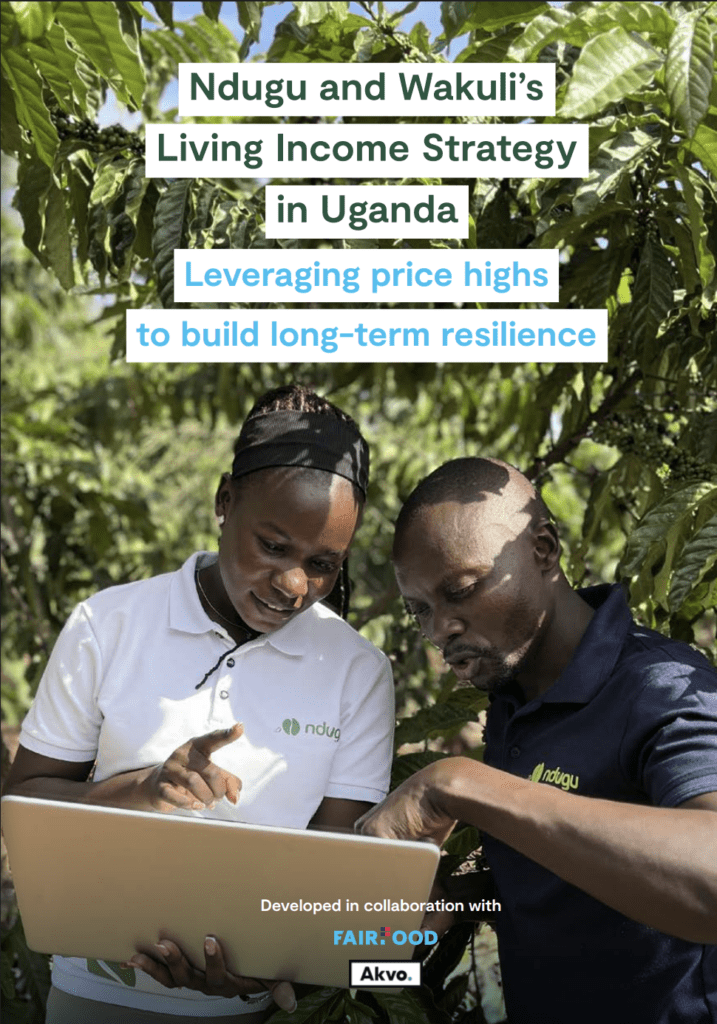
What we do

Understand real farmer livelihoods
We collected household- and farm-level data across the network of 1,250 Robusta farmers. This helps us identify actual production costs, income gaps, and the opportunities for improvement.
Co-design fair value interventions
With these insights, the partners work together to design practical, farmer-first actions: from pricing structures to regenerative support.

Make transparency standard practice
The goal is to create a replicable model that allows exporters and buyers to build contracts based on real data, and to communicate impact credibly.
Build capacity for long-term ownership
The programme strengthens Ndugu’s internal data team to manage and monitor data, analyse insights internally and use evidence in negotiations.
Meet our project partners