From Voices to Value: When the Hens Begin to Crow
On 31 March, the Royal Tropical Institute (KIT) in Amsterdam served as a backdrop for inspired exchange. Over 150 attendees gathered for the closing event of the RECLAIM Sustainability! programme (2021-2025), creating a rare intersection of perspectives that span the entire value chain. The takeaway from the event was clear: Global supply chains only thrive when we stop talking about producers and start talking with them.

Pictured from left to right: Sander de Jong, Mauricio Winkelried, Nanang Christianto, Nyabuhara Julian Rugyereza, Steven Collet, Bijoy Gopal Chakraborty, Fatmata Grace Okekearu ©Jaimi Nieli / Solidaridad
The RECLAIM Sustainability! consortium was well represented at this event, including our programme partners TrustAfrica, Business Watch Indonesia, and Solidaridad, as well as guests from the Netherlands Ministry of Foreign Affairs, the strategic partner in this 5-year collaboration.
A Legacy Handed Over
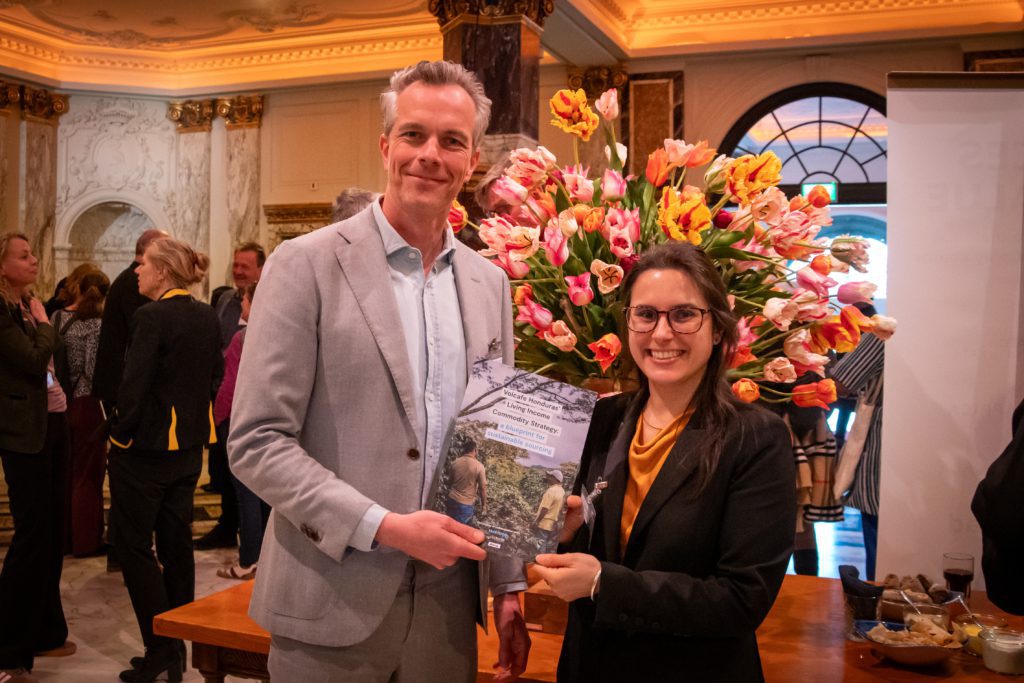
This event, opened by Isaac Kwadwo Gyamfi (Managing Director, Solidaridad West Africa), marked a milestone for the RECLAIM Sustainability! programme: the official handover of the Chronicles of Change catalogue to Steven Collet, Deputy Director-General International Cooperation at the Netherlands Ministry of Foreign Affairs.
The Chronicles of Change publication serves as both a mirror and a compass. It looks back to reflect on the essential work undertaken over the last five years, and looks forward to the next chapter of fostering inclusive progress. In a humbling keynote, Collet noted that in the current global climate of turmoil, seeing “democracy at work” throughout this programme was a source of pride for him.
In a world of increasing autocracy, this programme emphasizes the need for voices for the good. We have a lot to fight for, and a lot to lose. Steven Collet, Dutch Ministry of Foreign Affairs
In his introduction of the event’s speakers from across the world – Indonesia, India, Peru, Uganda and Sierra Leone – Sander de Jong, Managing Director at Fairfood, reminded the room that “numbers don’t tell the full story”. Nevertheless, the scale of the impact documented in the catalogue is undeniable:
- 1 million+ people have increased their bargaining power through equitable access to digital market intelligence or new business models.
- Over 20 million citizens have raised their voices to push policy agendas and influence societal norms.
- Hundreds of private and public sector policies have been improved to favor sustainable sourcing.
Changing the Proverb: Advocacy in Action
The afternoon’s narrative was anchored by Fatmata Grace Okekearu, Regional Coordinator for Women in the Media Sierra Leone (WIMSAL). She opened with a traditional saying from her home: “A hen does not crow; it is the rooster that crows.’’ This saying reflects a reality in which the voices of women are silenced. Grace explained: “When decisions are made without us, our rights are ignored and our contributions are not considered, despite us being the backbone of agriculture.’’
In Sierra Leone, women perform 65% of the agricultural labour, yet for years they fought to be heard in Parliament with little result. Through RECLAIM Sustainability! advocacy training, storytellers were transformed into effective dialogue partners. In 2022, this persistence led to the historic Customary Land Rights Act and the National Land Commission Act. Previously, customary law in Sierra Leone often barred women from owning or inheriting land. These new laws fundamentally shifted the power dynamic, legally guaranteeing women’s rights to own, use, and have a voice in the management of the land they have farmed for generations.
The project allowed women in Sierra Leone to finally smile. Now, we have a song that says ‘Side by side, side by side’. Not the men in the front and the women in the back, but men and women walking together. The proverbs are changing, and the hens are crowing. Fatmata Grace Okekearu, Women in the Media Sierra Leone (WIMSAL)

This theme of reclaiming power echoed throughout the other stories. Nyabuhara Julian Rugyereza, Chairperson of the National Association of Women in Tea (WiTU) in Uganda, shared the history of tea in her country. She noted that while women provide 70% of the labour, it was long branded a ‘man’s crop’, with women being excluded from decision-making. Under the RECLAIM Sustainability! programme, Julian helped form the National Association of Women in Tea Uganda, ensuring that women moved from the fields into the policy room.
The structural nature of these hurdles was also highlighted by Bijoy Gopal Chakraborty, president of the Confederation of Indian Small Tea Growers Associations (CISTA), who noted that “the challenge was not only production – it was representation’’. Find out more in this video story and how RECLAIM Sustainability! has supported small tea growers in India.
This sentiment was expanded upon by Nanang Christianto, Senior Advisor of Paguyuban Tani Lestari Tea Farmer Association in Indonesia, whose contribution with the Teh nDeso tea initiative emphasized that while global standards are set in boardrooms, their success is spent on the technological and social tools provided to producers on the ground.
In Peru, Mauricio Winkelried (Programme Manager at Solidaridad Latin America) spoke on behalf of the pallaqueras – women gold miners who manually seek discarded ore. Long invisible and undervalued, these women have made use of the RECLAIM Sustainability! initiative to build the National Network of Women Miners, transforming their gained visibility into structural influence within Peruvian Artisanal and Small-Scale Mining (ASM) governance.
Five years of RECLAIM Sustainability!
Throughout the RECLAIM Sustainability! programme, this focus on strengthening civil society and Gender Equality and Social Inclusion has been central to shifting power dynamics. The programme was implemented in strategic partnership with the Netherlands Ministry of Foreign Affairs, and driven by a consortium of Solidaridad, Fairfood, TrustAfrica and Business Watch Indonesia (BWI). It sought to contribute to genuine and inclusive sustainability in global supply chains across 17 countries and seven supply chains.
Three main pathways were leveraged to strengthen the position of producers and workers:
- Advocacy through inclusive dialogue: Influencing agendas and developing evidence-based solutions.
- Acceleration of disruptive innovations: Aiming to optimize the bargaining position of farmers and workers in the supply chains.
- Amplifying the voice of citizenry: Mobilizing, activating, and engaging citizens and Civil Society Organizations (CSOs) to change norms and influence the policy agenda.

The Business Case: Why Sustainable Means Competitive
The afternoon panel discussion challenged the notion that sustainability and profitability are at odds. This panel featured private sector representatives – sustainability directors from Albert Heijn (Laura Jungmann), Volcafe (Raphaelle Peinado), Rabobank (Lissy Smit), and HEMA (Marieke de Haan-Doolaard), as well as the Netherlands Ministry of Foreign Affairs (Isabelle van Tol). It was moderated by Heske Verburg (Managing Director, Solidaridad Europe).
The story that emerged was one of security through trust. Laura Jungmann shared how 60-year partnerships allowed Albert Heijn to support Moroccan suppliers through floods, creating a “trajectory of trust” that ensures quality when produce is scarce elsewhere. Marieke de Haan-Doolaard (HEMA) echoed this, noting that while long-term relationships (now 50% of their supplier base) involve shared risks, they provide a resilience that short-term “spot-buying” cannot match.
Lissy Smit (Rabobank) provided the financial sector’s perspective, noting that sustainability is the primary driver for risk assessment: “If you see that long-term resilience actually reduces risk, you can offer better pricing.“
A significant dilemma discussed was the shift of administrative burden. As EU regulations demand more data, the panel noted the risk of downloading those costs onto farmers at the beginning of the chain. Raphaelle Peinado (Volcafe) stressed that brands must consciously absorb these compliance costs. Marieke de Haan-Doolaard (HEMA) added that while 50% of their suppliers are long-term relationships, they must actively work on capacity building to ensure these partners can keep up with evolving standards.
The panel’s consensus was definitive: the false dilemma between profit and sustainability has run its course. In a volatile global market, competitiveness is now defined by the resilience of producers and the strength of the partnerships supporting them. By choosing to share the burden of transparency and investing in systemic change today, companies are building a trust that secures a stable supply for decades to come.

Nyabuhara Julian Rugyereza, Lissy Smit, Nanang Christianto, Marieke de Haan-Doolaard, Sander de Jong, Mauricio Winkelried, Raphaelle Peinado, Bijoy Gopal Chakraborty, Isabelle van Tol, Heske Verburg ©Jaimi Nieli / Solidaridad
The Momentum Must Continue
In the final round of the day’s key insights, Isaac Kwadwo Gyamfi (Managing Director, Solidaridad West Africa), brought it all together to emphasize the importance of collaboration by many to make impactful change. The RECLAIM Sustainability! programme (2021-2025) has laid the groundwork. The call to action at the event’s closing was clear: collective effort must increase. Short-term profits for the few can no longer be prioritized over the long-term livelihoods of the many.
Want to know more?
Chronicles of Change catalogue
RECLAIM Sustainability! website