When coffee prices fall, what keeps farming viable?
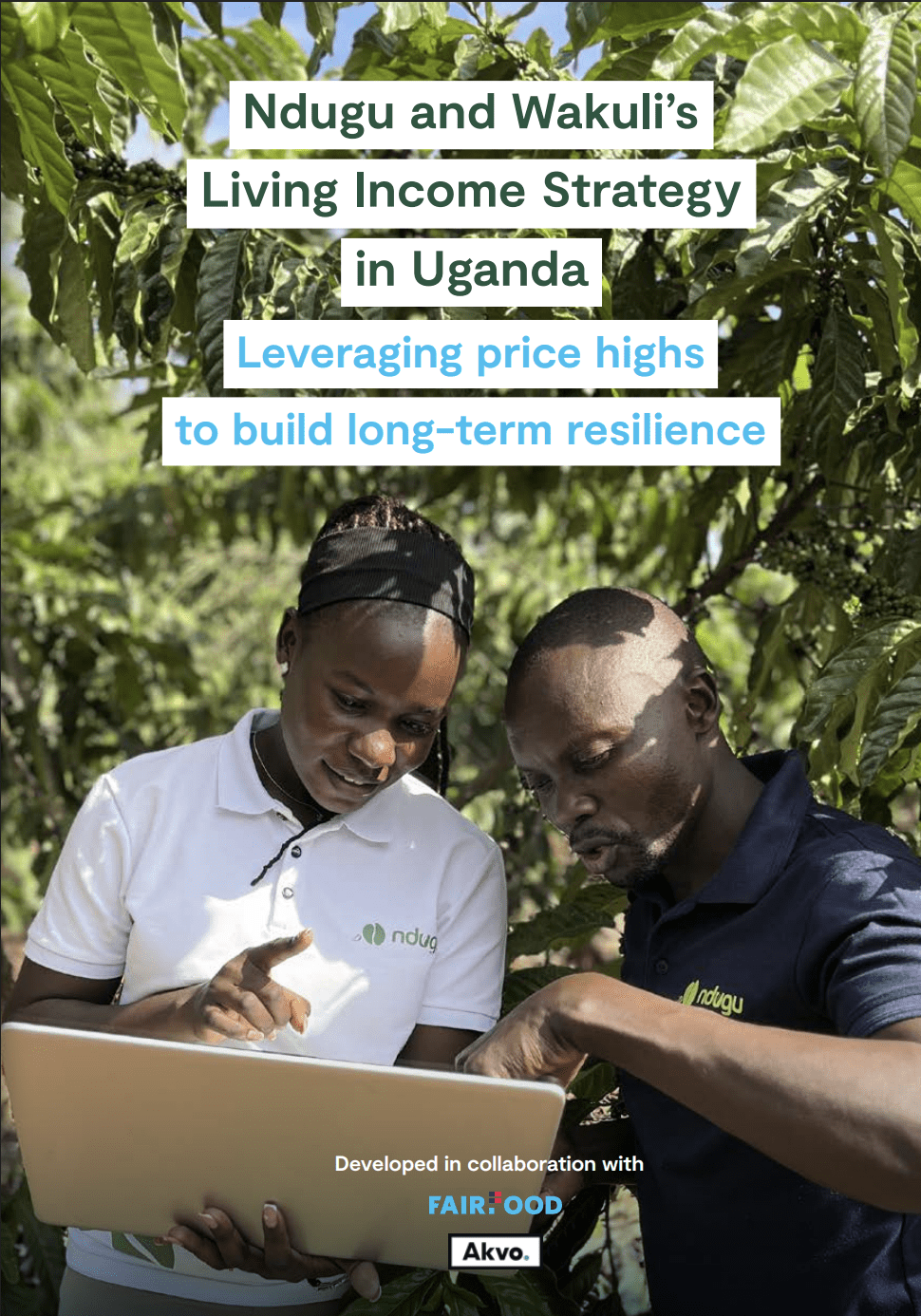
The latest Fairfood case study, the third in a series following Honduras and Sierra Leone, shows how Ndugu, a social enterprise supporting 32 coffee cooperatives and over 10,000 smallholder farmers in Uganda’s Masaka region, is using Fairfood’s Commodity Living Income Strategy to calculate Living Income Prices (LIP) and profile farmers by Cost–Yield Efficiency (CYE).
This research, carefully led by our data partners from Akvo, lays out the groundwork: survey data from 231 farmers turned abstract questions about price drops into concrete insights on who is at risk, under what conditions, and what levers can help sustain income. The results were compelling – and not only to Fairfood and Ndugu: Dutch roaster Wakuli, a Ndugu buyer, joined us in a new project to test interventions informed by the data to keep coffee farming viable over the long term.
What the study has shown
- High prices hide real risk: At current prices (median farmgate price USD 3.69/kg vs median LIP USD 2.87/kg), around 64% of farmers earn at least a living income — but this is highly dependent on the current price peak. A moderate price drop reduces this share to around 40%, and a severe drop pushes it below 20%, with high-cost, low-yield farmers affected first.
- Not all farmers face the same reality: Women and youth require higher LIPs than men and older farmers, largely due to smaller land sizes, household structures, and reliance on hired labour. Costs and yields also vary across cooperatives, translating into different LIPs and showing that organisational performance can be a major factor in income resilience.
- Data changes the conversation: Scenario modelling and segmentation transformed the vague question of “what happens when prices fall?” into practical decision-making tools. Insights now inform contract discussions, identify priority farmer groups, and guide cooperative support.
From insight to action
Building on these pilot findings, the work has moved into a second phase. Data has now been collected from 1,250 farmers, and two concrete interventions are being tested with Ndugu and Wakuli. Beyond analysis, the focus is on building Ndugu’s internal data capacity, with an in-house team trained to own and use the methodology themselves.
As we monitor results and prepare to share lessons from this next phase, you can already explore what the pilot revealed.
This work builds on the Living Income Commodity Strategy co-developed by Fairfood and Heifer International with support from the Dutch Ministry of Foreign Affairs. Our ongoing work with Ndugu and Wakuli is now being implemented as part of a new due diligence project under the Sustainable Agricultural Supply Chains Initiative (SASI-GIZ) , a key partner committed to grounding fair pricing discussions in shared evidence, not market swings alone.